
 Українська
 Русский
Knowledge lives in the mentor's head
When the person who holds the expertise goes on vacation or quits, the process stops. Half of how the company works is written down nowhere.
Build the company knowledge base once and repeat the training on every hire, every internal policy and every product update.
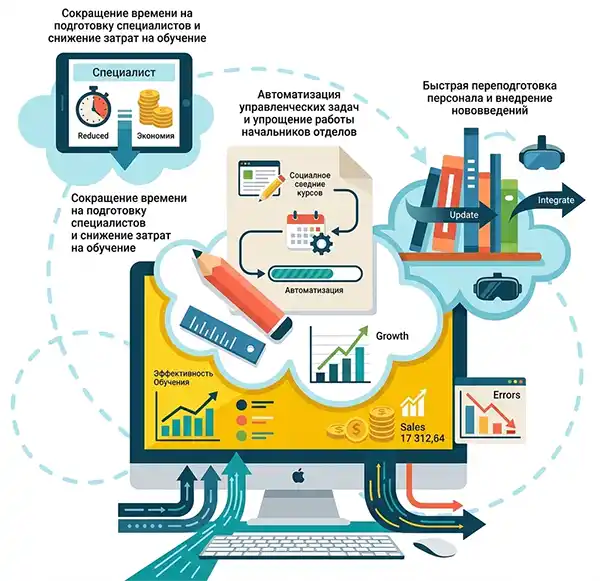
Training in a company usually exists, but it isn't measured. As long as it rests on individual people and email blasts, the department has neither the numbers nor any leverage.
Knowledge lives in the mentor's head
When the person who holds the expertise goes on vacation or quits, the process stops. Half of how the company works is written down nowhere.
Nobody counts training coverage
How many employees actually finished the program, how many got stuck halfway and how many never started — there is no data. There is a list of people who were invited.
The policy went out, but who read it is unclear
The change to the policy went out by email. It was read selectively, understood differently by everyone, and nobody has any proof they saw it.
Onboarding costs as much every time as it did the first time
An experienced employee spends working hours retelling the same thing to every newcomer. Everyone gets their own version of the truth: one person was told about the exception to the policy, another was not. And if someone leaves during probation, everything invested is written off and the cycle starts over — except the bill for it shows up nowhere.
The training budget can't be defended with numbers
When the CFO asks what training delivered over the year, the department has attendance at trainings and free-form feedback. No coverage, no trend in results, no comparison between units. So the budget is cut first, because it is the only one whose return can't be shown in a table.
On the left — how corporate training is set up in most companies. On the right — how the same job looks after a one-time setup.
The working hours of an experienced employee go into retelling the basics to every newcomer.
Internal policies, the product, the values and the job descriptions are written down in lessons. The mentor steps in for questions that matter, not for the intro briefing.
A “read and understood” mark says nothing about actual knowledge.
The next module won't open until the assignment for the current one is passed. Points are counted automatically and add up into a report.
A salesperson gets the same thing as an accountant, and half the material misses the mark.
Everyone takes the shared block about the company, and specialized modules are assigned by group. A curator adds separate lessons to an employee where they are needed.
The email is read selectively, and who has actually seen it is unknown.
The lesson is assigned to the right group, the chatbot sends the notification, the test confirms the material landed, and the report shows by name who completed it and with what result.
There is attendance at trainings and there is feedback, but no data for a conversation with finance.
A performance table for every employee and group, time spent per lesson, points for the course, completion statistics in percent, export to a file.
Bringing in an outside lecturer means opening up information on the entire staff to them.
A lecturer sees results only for their own lessons, a curator sees their own group, and the full picture goes to the account owner and the roles they assign.
The jobs that usually make an L&D department start looking for an LMS in the first place.
The situation
Training was run by the location managers, each in their own way. Knowing the product range and the service standards depended on who got lucky with a mentor. There was nothing to check a salesperson's level with before they went on shift.
What we did
We put together a course on the product and the service standards and split it into modules with stop-lessons. We added a final test as the condition for being cleared to work. The managers became curators of their own groups.
The result
Every location teaches the same thing. The head of retail sees in the report which location is falling behind and on exactly which block. A new collection rolls out to the whole chain in a single lesson.
The situation
As the team grew, the intro briefing turned into a separate job for the team leads. Some newcomers left during probation, and all the time invested was written off. The only way to tell whether a person was ready for the work was from their mistakes.
What we did
We recorded a welcome course: the company, the processes, the tools, the department's internal policies. We added an assessment with auto-grading. Part of the course started being opened to candidates before the offer.
The result
A newcomer arrives prepared and doesn't spend the first week hunting for the answer to “where do I look this up”. The team lead steps in for questions that matter. Readiness is visible in the report, not in mistakes on live work.
The situation
Changes to the rules were sent out by email and the signatures were collected in a logbook. Whether a person read the document or signed without looking was impossible to check. In an inspection there was nothing to show but a signature.
What we did
We moved the mandatory briefings into lessons with a test at the end. We set up assignment by department groups, chatbot notifications and a deadline for completion.
The result
Instead of a signature in a logbook — a passed test with points, a date and the number of attempts. The report shows by name who completed it and who missed the deadline, and it can be exported to a file.
Five steps that are set up once and then repeat on every hire and every update to an internal policy.
You updated a policy — every employee who needs it got the new lesson and confirmed with a test that it landed
It isn't enough for a corporate LMS to play video. It has to give management numbers, and give the security team confidence that employee data isn't drifting off into contractors' accounts.

15 days of full access: knowledge base, tests, groups, roles and reports. That is enough to bring management a working example with numbers instead of an idea.
No card needed. We'll help with the setup and with moving your materials over.